After the election of Long ally Oscar K. Allen to the governorship in 1932, Huey continued to exercise de facto control of state government and made frequent trips to Baton Rouge to push his bills through the legislature.
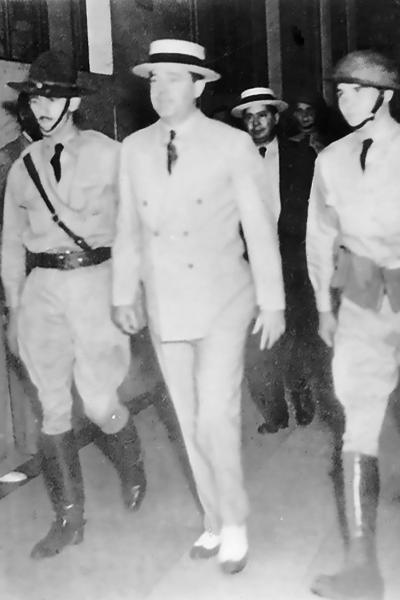
Huey Long surrounded by armed guards in the Louisiana State Capitol ~ Courtesy of LSU Libraries Special Collections.
After death threats, arson attempts, and a drive-by shooting at his New Orleans home, Huey beefed up his personal security, surrounding himself with armed bodyguards from the state police. Huey also worried about his family’s safety and was concerned that his children may be kidnapped. The threats only strengthened his resolve to crush his political opponents.
Completely stymied by Long's political maneuvers and legislative victories, his enemies formed a paramilitary organization called the Square Deal Association to plot armed insurrection. The movement likened itself to the 1874 white supremacist uprising against the state’s Reconstruction government.
In January 1935, 200 armed Square Dealers stormed the East Baton Rouge Parish courthouse, prompting Governor Allen to call out the National Guard and declare martial law.
In July, Huey declared that he had discovered an assassination plot against him. Long’s associates had eavesdropped on a secret meeting in New Orleans, which included four Louisiana congressmen, New Orleans Mayor Walmsley, and former Governors Parker and Sanders. Another man, identified as “Dr. Wise,” was introduced at the gathering.
Huey Long Shot and Killed
On September 8, Huey was in the State Capitol in Baton Rouge for a special session of the Louisiana legislature, pushing through a number of bills including a measure to gerrymander opponent Judge Benjamin Pavy out of his job. According to the generally accepted version of events, Pavy’s son-in-law, Dr. Carl Weiss, approached Huey in a corridor and shot him at close range in the abdomen. Huey’s bodyguards immediately opened fired on Weiss as Huey ran to safety.
Weiss was killed instantly, and Huey was rushed to a nearby hospital, where emergency surgery failed to stop internal bleeding.
Huey died two days later on September 10, 1935, eleven days after his 42nd birthday. His last words were, “God, don’t let me die. I have so much to do.”
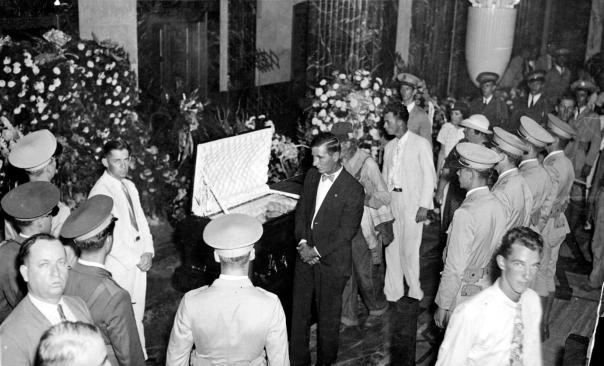
Mourners process by Huey Long's casket lying in state at the Louisiana State Capitol ~ Courtesy of LSU Libraries Special Collections.